Vitamin D, Sunlight, and Your Health: What Does a Level Below 30 Really Mean?
Vitamin D is commonly called the "sunshine vitamin," but that nickname barely captures its role in the body. Vitamin D participates in calcium and phosphorus regulation, bone mineralization, muscle function, and a wide range of cellular processes. When it becomes significantly deficient, the effects can reach well beyond what most people picture when they hear the word "vitamin."
There is another piece of this conversation that often gets missed: sunlight has a timing, an intensity, and a spectrum. Morning light, UVA, and UVB are not interchangeable, and understanding the differences helps us make smarter decisions about both vitamin D and responsible sun exposure. At Quantum Chiropractic, we like to look at the whole picture, and vitamin D is a good example of why the number on a lab report is only the starting point.
First: What Does "Vitamin D Below 30" Mean?
The blood test generally used to check vitamin D status measures 25-hydroxyvitamin D, written as 25(OH)D and reported in ng/mL. That is different from IU, which refers to the amount of vitamin D you take in through food or supplements.
Here is a general way to read the numbers:
- Below 12 ng/mL is associated with vitamin D deficiency.
- 12 to under 20 ng/mL is generally considered inadequate.
- 20 ng/mL or above is adequate for most healthy people.
- Above roughly 50 ng/mL may be associated with adverse effects in some circumstances.
The Endocrine Society's current guideline no longer treats 30 ng/mL as a universal line that every healthy adult must clear, because clinical trials have not pinned down one specific concentration that optimizes every health outcome. From a functional-health perspective, though, a result below 30 can still prompt a useful question: why is the level there, and does it fit with anything else happening in this person's health?
Vitamin D's Most Established Jobs
Vitamin D helps the intestine absorb calcium and phosphorus and supports the mineral environment the body needs to build healthy bone. When vitamin D runs significantly low, calcium absorption declines. The body may respond by raising parathyroid hormone, which helps keep blood calcium steady partly by pulling calcium out of skeletal tissue.
Over time, significant deficiency can contribute to:
- Osteomalacia in adults and rickets in children
- Bone pain and skeletal weakness
- Proximal muscle weakness
- Muscle cramping tied to disturbed mineral physiology
- Poorer physical function overall
Muscles, Strength, and Movement
When vitamin D is substantially deficient, people can notice muscle weakness, difficulty getting out of a chair or climbing stairs, reduced lower-body strength, general muscular discomfort, lower exercise tolerance, and poorer physical performance. When muscles do not work well, the joints they stabilize may have to work differently. Movement becomes less efficient, activity often drops, and deconditioning can compound an existing back, hip, knee, or balance problem.
One important distinction: vitamin D deficiency does not directly cause arthritis or degenerative joint disease. It is better understood as one factor that can influence the environment in which bones, muscles, and joints have to function.
Energy, Mood, and the Brain
Low vitamin D has been linked with fatigue, lower mood, depressive symptoms, reduced motivation, cognitive complaints, and lower physical vitality. But association is not the same as causation. People who are ill, inactive, depressed, or rarely outdoors may also carry lower vitamin D levels, so vitamin D is best viewed as one potentially modifiable piece of a larger clinical picture rather than the sole explanation.
Immune and Metabolic Health
Vitamin D receptors show up throughout many tissues, including immune cells. Research has connected vitamin D status with innate and adaptive immunity, inflammatory signaling, glucose metabolism, insulin sensitivity, autoimmune disease, and respiratory infection risk. That said, the observational associations have generally been stronger than the evidence that supplementation prevents all of these conditions. Vitamin D is biologically important, but it should not be sold as a cure-all.
The Missing Piece: Sunlight
Most vitamin D conversations jump straight to supplements. But the skin can manufacture vitamin D on its own, and to understand how, it helps to separate UVA from UVB.
UVB: The Vitamin-D-Producing Wavelength
UVB radiation, roughly 290 to 320 nanometers, reaches exposed skin and converts a compound called 7-dehydrocholesterol into previtamin D3, which then becomes vitamin D3. That makes UVB the part of sunlight directly responsible for vitamin D production in the skin.
When the sun sits low on the horizon, its light travels through more atmosphere, and a larger share of UVB gets filtered out before it reaches the ground. As the sun climbs higher, more UVB gets through. In other words, the brightest-looking part of the day is not automatically the same as meaningful vitamin D production.
UVA: Different Biology
UVA occupies roughly 315 to 400 nanometers and penetrates more deeply into the skin than UVB, but it does not produce vitamin D. Researchers are studying vitamin-D-independent effects of sunlight, including UVA-driven release of nitric-oxide compounds from the skin. These findings are interesting, but they do not establish UVA exposure as a treatment for high blood pressure or heart disease. What UVA does clearly contribute to is photoaging, oxidative and DNA damage in the skin, and, alongside UVB, skin-cancer risk.
Your Body Responds Differently to Sunlight Throughout the Day
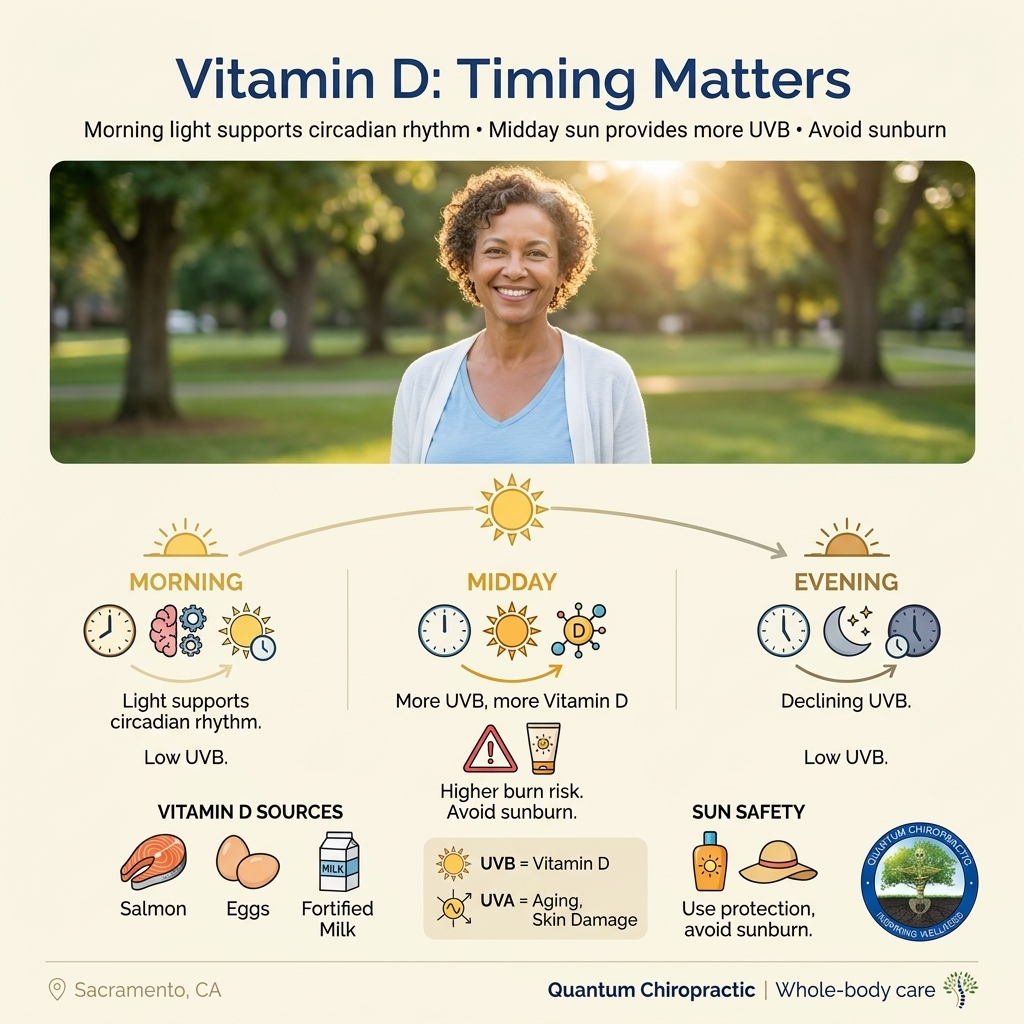
Morning: Think Circadian Rhythm
Outdoor morning light can be valuable even when there is not enough UVB to make much vitamin D. The eyes and brain use the light-dark cycle to help synchronize wakefulness, sleep timing, melatonin rhythm, and overall daily biological timing.
A reasonable habit is getting outside within an hour or so of waking for about 10 to 30 minutes of bright outdoor light. This is about circadian timing, not UVB dosing. And keep in mind that even cloudy outdoor light is usually far brighter than indoor lighting, often by a wide margin.
Midday: Think UVB, and Respect the Dose
UV radiation is strongest when the sun is high. In the continental United States, CDC guidance notes that UV rays are generally strongest between 10 a.m. and 4 p.m. during daylight-saving time. This is when vitamin-D-producing UVB is most available, and it is also when sunburn risk climbs the fastest. The tradeoff is real: the time of day that is most efficient for vitamin D synthesis is the same window in which excess UV can damage skin most quickly.
How Much Sun Do We Actually Need?
There is no universal answer. According to the NIH Office of Dietary Supplements, some experts have suggested that roughly 5 to 30 minutes of exposure between 10 a.m. and 4 p.m., either daily or at least twice weekly, to areas such as the face, arms, hands, and legs may provide enough vitamin D production for many people. But that range should not be turned into a blanket prescription, because the real number depends on many variables:
- Skin pigmentation, age, and how much skin is exposed
- Latitude, season, time of day, and elevation
- Cloud cover and air pollution
- Clothing and sunscreen
A 2024 modeling study across global latitudes found that required UVB exposure times could vary dramatically with latitude, season, and skin type, and the authors specifically cautioned that their modeled times were not meant to be a sun-exposure prescription.
A Better Rule: Avoid the Burn
Sunburn is evidence of excessive UV injury. More exposure after the skin has received what it needs does not simply translate into "more vitamin D." The goal should never be to deliberately tan or burn.
The American Academy of Dermatology takes a conservative position: there is no known UV exposure level that maximizes vitamin D production without adding skin-cancer risk. For that reason, they recommend getting vitamin D from food and supplements rather than intentionally exposing unprotected skin to UV. Extra caution makes sense for anyone with a previous melanoma or other skin cancer, a strong family history of skin cancer, photosensitivity disorders, sun-sensitizing medications, very fair skin, or numerous or atypical moles.
Why Sitting by a Window Does Not Work for Vitamin D
Ordinary window glass blocks essentially all UVB. Some UVA and visible light pass through, but the UVB wavelengths your skin needs for vitamin D production largely do not. So sunlight through a window can give you useful visible light, but it contributes little to no vitamin-D-producing UVB.
Food Still Matters
Diet is a dependable source, especially when sun exposure is limited. Good options include:
- Fatty fish such as salmon, sardines, and trout
- Egg yolks
- Fortified dairy products and fortified plant milks
- Other fortified foods
- UV-exposed mushrooms, which primarily provide vitamin D2
Because vitamin D is fat-soluble, pairing it with a meal that contains some dietary fat improves absorption.
Supplementation: More Is Not Always Better
Vitamin D supplements can be very useful when intake or sun exposure falls short. But because vitamin D is fat-soluble, it can accumulate, and excessive supplementation can lead to toxicity and hypercalcemia. Warning signs of too much can include nausea, weakness, excessive thirst, frequent urination, kidney stones, kidney injury, and, in severe cases, cardiac rhythm disturbances. More is not automatically better.
What Should You Take Away From This?
Think of vitamin D as one part of a larger system that ties together sunlight, skin, vitamin D metabolism, calcium and phosphorus regulation, bones, and muscles, while also interacting with many other tissues. A quick way to hold the whole picture:
- Morning outdoor light is a strong circadian signal with little emphasis on vitamin D.
- Higher, midday sun makes more UVB available and synthesizes vitamin D more efficiently, but carries higher burn risk.
- Late afternoon and evening bring declining UVB and less efficient production.
- Food and supplements are useful when sunlight is limited, unsafe, or inadequate.
A thoughtful strategy combines regular outdoor daylight, responsible UV exposure without burning, vitamin-D-containing foods, appropriate supplementation when needed, testing when it is clinically indicated, and interpreting the result in context rather than reacting to the number alone.
This article is intended for educational purposes and is not individual medical advice. Vitamin D requirements and safe sun exposure vary considerably from person to person. People with kidney disease, calcium disorders, sarcoidosis or other granulomatous diseases, a history of kidney stones, photosensitivity, skin-cancer risk, or medications affecting vitamin D or calcium metabolism should discuss supplementation and sun exposure with an appropriate healthcare professional.